Testing Blog
Introducing DOM Snitch, our passive in-the-browser reconnaissance tool
Tuesday, June 21, 2011
By Radoslav Vasilev from Google Zurich
Every day modern web applications are becoming increasingly sophisticated, and as their complexity grows so does their attack surface. Previously we introduced open source tools such as
Skipfish
and
Ratproxy
to assist developers in understanding and securing these applications.
As existing tools focus mostly on testing server-side code, today we are happy to introduce
DOM Snitch
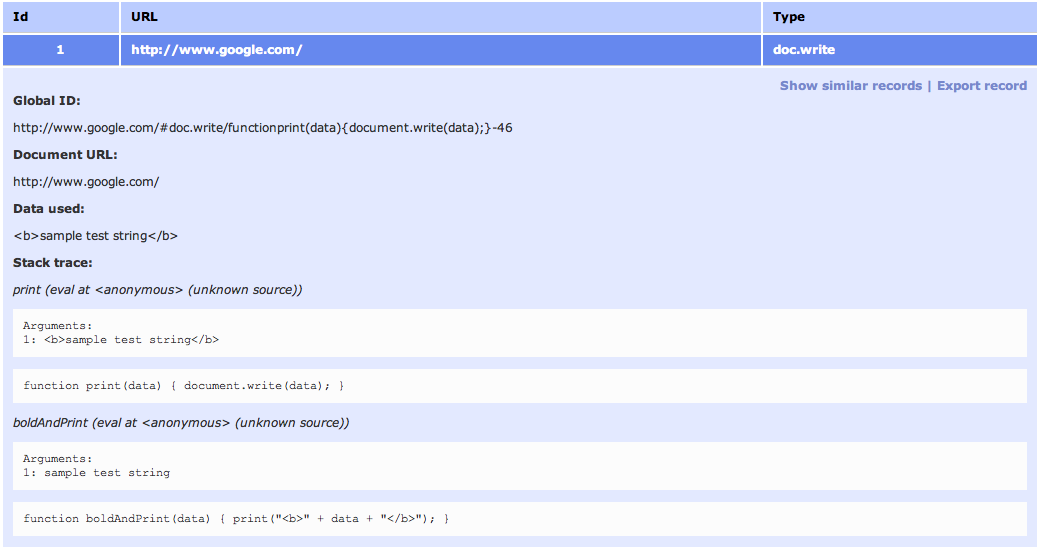
— an experimental* Chrome extension that enables developers and testers to identify insecure practices commonly found in client-side code. To do this, we have adopted
several approaches
to intercepting JavaScript calls to key and potentially dangerous browser infrastructure such as document.write or HTMLElement.innerHTML (among
others
). Once a JavaScript call has been intercepted, DOM Snitch records the document URL and a complete stack trace that will help assess if the intercepted call can lead to cross-site scripting, mixed content, insecure modifications to the
same-origin policy for DOM access
, or other client-side issues.
Here are the benefits of DOM Snitch:
Real-time:
Developers can observe DOM modifications as they happen inside the browser without the need to step through JavaScript code with a debugger or pause the execution of their application.
Easy to use:
With built-in
security heuristics
and nested views, both advanced and less experienced developers and testers can quickly spot areas of the application being tested that need more attention.
Easier collaboration:
Enables developers to easily export and share captured DOM modifications while troubleshooting an issue with their peers.
DOM Snitch is intended for use by developers, testers, and security researchers alike.
Click here
to download DOM Snitch. To read the documentation, please visit
this page
.
*Developers and testers should be aware that DOM Snitch is currently experimental. We do not guarantee that it will work flawlessly for all web applications. More details on known issues can be found
here
or in the project’s
issues tracker
.
No comments
GTAC 2011 Keynotes
Thursday, June 16, 2011
By James Whittaker
I am pleased to confirm 3 of our keynote speakers for GTAC 2011 at the Computer History Museum in Mountain View CA.
Google's own
Alberto Savoia
, aka Testivus.
Steve McConnell
the best selling author of
Code Complete
and CEO of Construx Software.
Award winning speaker ("the Jon Stewart of Software Security")
Hugh Thompson
.
This is the start of an incredible lineup. Stay tuned for updates concerning their talks and continue to nominate additional speakers and keynotes. We're not done yet and we're taking nominations through mid July.
In addition to the keynotes, we're going to be giving updates on How Google Tests Software from teams across the company including Android, Chrome, Gmail, You Tube and many more.
2 comments
Tuesday, June 14, 2011
(Cross-posted from the
Google Engineering Tools blog
)
By Pooja Gupta, Mark Ivey and John Penix
Continuous integration systems play a crucial role in keeping software working while it is being developed. The basic steps most continuous integration systems follow are:
1. Get the latest copy of the code.
2. Run all tests.
3. Report results.
4. Repeat 1-3.
This works great while the codebase is small, code flux is reasonable and tests are fast. As a codebase grows over time, the effectiveness of such a system decreases. As more code is added, each clean run takes much longer and more changes gets crammed into a single run. If something breaks, finding and backing out the bad change is a tedious and error prone task for development teams.
Software development at
Google is big and fast
. The code base receives
20+ code changes per minute and 50% of the files change every month
! Each product is developed and released from ‘head’ relying on automated tests verifying the product behavior. Release frequency varies from multiple times per day to once every few weeks, depending on the product team.
With such a huge, fast-moving codebase, it is possible for teams to get stuck spending a lot of time just keeping their build ‘green’. A continuous integration system should help by providing the
exact
change at which a test started failing, instead of a range of suspect changes or doing a lengthy binary-search for the offending change. To find the exact change that broke a test, we could run every test at every change, but that would be very expensive.
To solve this problem, we built a continuous integration system that uses dependency analysis to determine all the tests a change transitively affects and then runs only those tests for every change. The system is built on top of Google’s cloud computing infrastructure enabling many builds to be executed concurrently, allowing the system to run affected tests as soon as a change is submitted.
Here is an example where our system can provide faster and more precise feedback than a traditional continuous build. In this scenario, there are two tests and three changes that affect these tests. The gmail_server_tests are broken by the second change, however a typical continuous integration system will only be able to tell that either change #2 or change #3 caused this test to fail. By using concurrent builds, we can launch tests without waiting for the current build/test cycle to finish. Dependency analysis limits the number of tests executed for each change, so that in this example, the total number of test executions is the same as before.
Let’s look deeper into how we perform the dependency analysis.
We maintain an in-memory graph of coarse-grained dependencies between various tests and build rules across the entire codebase. This graph, several GBs in-memory, is kept up-to-date with each change that gets checked in. This allows us to transitively determine all tests that depend on the code modified in a given change and hence need to be re-run to know the current state of the build. Let’s walk through an example.
Consider two sample projects, each containing a different set of tests:
where the build dependency graph looks like this:
We will see how two isolated code changes, at different depths of the dependency tree, are analyzed to determine affected tests, that is the minimal set of tests that needs to be run to ensure that both Gmail and Buzz projects are “green”.
Case1: Change in common library
For first scenario, consider a change that modifies files in
common_collections_util
.
As soon as this change is submitted, we start a breadth-first search to find all tests that depend on it.
Once all the direct dependencies are found, continue BFS to collect all transitive dependencies till we reach all the leaf nodes.
When done, we have all the tests that need to be run, and can calculate the projects that will need to update their overall status based on results from these tests.
Case2: Change in a dependent project:
When a change modifying files in
youtube_client
is submitted.
We perform the same analysis to conclude that only
buzz_client_tests
is affected and status of Buzz project needs to be updated:
The example above illustrates how we optimize the number of tests run per change without sacrificing the accuracy of end results for a project. A lesser number of tests run per change allows us to run all
affected
tests for every change that gets checked in, making it easier for a developer to detect and deal with an offending change.
Use of smart tools and cloud computing infrastructure in the continuous integration system makes it fast and reliable. While we are constantly working on making improvements to this system, thousands of Google projects are already using it to launch-and-iterate quickly and hence making faster user-visible progress.
14 comments
How Google Tests Software - Part Seven
Thursday, May 26, 2011
By James Whittaker
The Life of a TE
The Test Engineer is a newer role within Google than either SWEs or SETs. As such, it is a role still in the process of being defined. The current generation of Google TEs are blazing a trail which will guide the next generation of new hires for this role. It is the process that is emerging as the best within Google that we present here.
Not all products require the services of a TE. Experimental efforts and early stage products without a well-defined mission or user story are certainly projects that won’t get a lot of TE attention. If the product stands a good chance of being cancelled (in the sense that as a proof of concept it fails to pass muster) or has yet to engage users or have a well defined set of features, testing it is largely something that should be done by the people developing it.
Even if it is clear that a product is going to get shipped, Test Engineers have little to do early in the development cycle when features are still in flux and the final feature list and scope is undetermined. Overinvesting in testing too early can mean a lot of things get thrown away. Likewise, early testing planning requires fewer test engineers than later cycle exploratory testing when the product is close to final form and the hunt for missed bugs has a greater urgency.
The trick in staffing a project with Test Engineers has to do with risk and return on investment. Risk to the customer and to the enterprise means more testing effort and requires more TEs. But that effort needs to be in proportion to the potential return. We need the right number of TEs and we need them to engage at the right time and with the right impact.
Once engaged, TEs do not have to start from scratch. There is a great deal of test engineering and quality-oriented work performed by SWEs and SETs which is the starting point for additional TE work. The initial engagement of the TE is to decide things such as:
· Where are the weak points in the software?
· What are the security, privacy, performance and reliability concerns?
· Do all the primary user scenarios work as expected? For all international audiences?
· Does the product interoperate with other products (hardware and software)?
· In the event of a problem, how good are the diagnostics?
All of this combines to speak to the risk profile of releasing the software in question. TEs don’t necessarily do all of this work, but they ensure that it gets done and they leverage the work of others is assessing where additional work is required. Ultimately, test engineers are paid to protect users and the business from bad design, confusing UX, functional bugs, security and privacy issues and so forth. At Google, TEs are the only people on a team whose full-time job is to look at the product or service holistically for weak points. As such, the life of a Test Engineer is much less prescriptive and formalized than that of an SET. TE’s are asked to help on projects in all stages of readiness: everything from the idea stage to version 8, or even watching over a deprecated or “mothballed” project. Often, a single TE will even span multiple projects particularly those with specialty type skills like security.
Obviously, the work of a TE varies greatly depending on the project. Some TE’s spend much of their time programming, much like an SET, but with more of a focus on end-to-end user scenarios. Other TE's take existing code and designs determine failure modes and look for errors that will cause those failures. In such a role a TE might modify code but not create it from scratch. TE's must be more systematic and thorough in their test planning and completeness with a focus on the actual usage and system experience. TE's excel at dealing with ambiguity in requirements and at reasoning and communicating about fuzzy problems.
Successful TEs accomplish all this while navigating the sensitivities and sometimes strong personalities of the development and product team members. When weak points are found, test engineers happily break the software, and drive to get these issues resolved with the SWEs, PMs, and SETs.
Such a job description is a frightening prospect given the mix of technical skill, leadership, and deep product understanding and without proper guidance it is a role in which many would expect to fail. But at Google a strong community of test engineers has emerged to counter this. Of all job functions, the TE role is perhaps the best peer supported role in the company and the insight and leadership required to perform it successfully means that many of the top test managers in the company come from the TE ranks.
There is a fluidity to the work of a Google Test Engineer that belies any prescriptive process for engagement. TE’s can enter a project at any point and must assess the state of the project, code, design, and users quickly and decide what to focus on first. If the project is just getting started, test planning is often the first order of business. Sometimes TEs are pulled in late in the cycle to evaluate whether a project is ready for ship or if there are any major issues before an early ‘beta’ goes out. If they are brought into a newly acquired application or one in which they have little prior experience, they will often start doing some exploratory testing with little to no planning. Sometimes projects haven’t been released for quite a while and just need some touchups/security fixes, or UX updates—calling for an even different approach. One size rarely fits all for TEs at Google.
16 comments
GTAC 2011 Open for Submission
Friday, May 20, 2011
By James Whittaker
I am happy to announce that
GTAC 2011
is now
open for nominations
. We're going to try and have an executive session, depending on interest, the afternoon/evening of October 25th at the Googleplex in Mountain View. This session is intended for top testing decision makers at top web, technology and software companies worldwide. It will be a chance for frank and open discussion about ours and the industry's collective challenges. It's intended to be a meeting of key decision makers and budget owners to share information, ideas and with a little luck spur some collaborations that will be good for the testing industry overall. Nominate your executive
here
.
The general session is by invitation only and prospective attendees and speakers must register and be selected. Speaker nominees are encouraged to point us to videos of prior presentations and any other material to help make our decision easier.
Please leave comments if there is some technology, tool or product you want to hear about so we end up with the best possible agenda.
I hope to see a lot of our readers in Mountain View in October!
3 comments
Labels
TotT
113
GTAC
61
James Whittaker
42
Misko Hevery
32
Code Health
31
Anthony Vallone
27
Patrick Copeland
23
Jobs
18
Andrew Trenk
13
C++
11
Patrik Höglund
8
JavaScript
7
Allen Hutchison
6
George Pirocanac
6
Zhanyong Wan
6
Harry Robinson
5
Java
5
Julian Harty
5
Adam Bender
4
Alberto Savoia
4
Ben Yu
4
Erik Kuefler
4
Philip Zembrod
4
Shyam Seshadri
4
Chrome
3
Dillon Bly
3
John Thomas
3
Lesley Katzen
3
Marc Kaplan
3
Markus Clermont
3
Max Kanat-Alexander
3
Sonal Shah
3
APIs
2
Abhishek Arya
2
Alan Myrvold
2
Alek Icev
2
Android
2
April Fools
2
Chaitali Narla
2
Chris Lewis
2
Chrome OS
2
Diego Salas
2
Dori Reuveni
2
Jason Arbon
2
Jochen Wuttke
2
Kostya Serebryany
2
Marc Eaddy
2
Marko Ivanković
2
Mobile
2
Oliver Chang
2
Simon Stewart
2
Stefan Kennedy
2
Test Flakiness
2
Titus Winters
2
Tony Voellm
2
WebRTC
2
Yiming Sun
2
Yvette Nameth
2
Zuri Kemp
2
Aaron Jacobs
1
Adam Porter
1
Adam Raider
1
Adel Saoud
1
Alan Faulkner
1
Alex Eagle
1
Amy Fu
1
Anantha Keesara
1
Antoine Picard
1
App Engine
1
Arham Jain
1
Ari Shamash
1
Arif Sukoco
1
Bartosz Papis
1
Benjamin Pick
1
Bob Nystrom
1
Bruce Leban
1
Carlos Arguelles
1
Carlos Israel Ortiz García
1
Cathal Weakliam
1
Christopher Semturs
1
Clay Murphy
1
Dagang Wei
1
Dan Maksimovich
1
Dan Shi
1
Dan Willemsen
1
Dave Chen
1
Dave Gladfelter
1
David Bendory
1
David Mandelberg
1
Derek Snyder
1
Diego Cavalcanti
1
Dmitry Vyukov
1
Eduardo Bravo Ortiz
1
Ekaterina Kamenskaya
1
Elliott Karpilovsky
1
Elliotte Rusty Harold
1
Espresso
1
Felipe Sodré
1
Francois Aube
1
Gene Volovich
1
Google+
1
Goran Petrovic
1
Goranka Bjedov
1
Hank Duan
1
Havard Rast Blok
1
Hongfei Ding
1
Jason Elbaum
1
Jason Huggins
1
Jay Han
1
Jeff Hoy
1
Jeff Listfield
1
Jessica Tomechak
1
Jim Reardon
1
Joe Allan Muharsky
1
Joel Hynoski
1
John Micco
1
John Penix
1
Jonathan Rockway
1
Jonathan Velasquez
1
Josh Armour
1
Julie Ralph
1
Kai Kent
1
Kanu Tewary
1
Karin Lundberg
1
Kaue Silveira
1
Kevin Bourrillion
1
Kevin Graney
1
Kirkland
1
Kurt Alfred Kluever
1
Kyle Freeman
1
Manjusha Parvathaneni
1
Marek Kiszkis
1
Marius Latinis
1
Mark Ivey
1
Mark Manley
1
Mark Striebeck
1
Matt Lowrie
1
Meredith Whittaker
1
Michael Bachman
1
Michael Klepikov
1
Mike Aizatsky
1
Mike Wacker
1
Mona El Mahdy
1
Noel Yap
1
Palak Bansal
1
Patricia Legaspi
1
Per Jacobsson
1
Peter Arrenbrecht
1
Peter Spragins
1
Phil Norman
1
Phil Rollet
1
Pooja Gupta
1
Project Showcase
1
Radion Khait
1
Radoslav Vasilev
1
Rahul Singal
1
Rajat Dewan
1
Rajat Jain
1
Rich Martin
1
Richard Bustamante
1
Roman Govsheev
1
Roshan Sembacuttiaratchy
1
Ruslan Khamitov
1
Saicharan Nimmala
1
Sam Lee
1
Sean Jordan
1
Sebastian Dörner
1
Shahar Roth
1
Sharon Zhou
1
Shiva Garg
1
Siddartha Janga
1
Simran Basi
1
Stan Chan
1
Stephen Ng
1
Tejas Shah
1
Test Analytics
1
Test Engineer
1
Tim Lyakhovetskiy
1
Tom O'Neill
1
Vojta Jína
1
Zhe Lu
1
automation
1
dead code
1
iOS
1
mutation testing
1
Archive
▼
2026
(7)
▼
Jul
(1)
Prefactoring: Clear the Way for Your New Feature
►
Jun
(1)
►
May
(2)
►
Apr
(1)
►
Mar
(2)
►
2025
(3)
►
Oct
(1)
►
Sep
(1)
►
Jan
(1)
►
2024
(13)
►
Dec
(1)
►
Oct
(1)
►
Sep
(1)
►
Aug
(1)
►
Jul
(1)
►
May
(3)
►
Apr
(3)
►
Mar
(1)
►
Feb
(1)
►
2023
(14)
►
Dec
(2)
►
Nov
(2)
►
Oct
(5)
►
Sep
(3)
►
Aug
(1)
►
Apr
(1)
►
2022
(2)
►
Feb
(2)
►
2021
(3)
►
Jun
(1)
►
Apr
(1)
►
Mar
(1)
►
2020
(8)
►
Dec
(2)
►
Nov
(1)
►
Oct
(1)
►
Aug
(2)
►
Jul
(1)
►
May
(1)
►
2019
(4)
►
Dec
(1)
►
Nov
(1)
►
Jul
(1)
►
Jan
(1)
►
2018
(7)
►
Nov
(1)
►
Sep
(1)
►
Jul
(1)
►
Jun
(2)
►
May
(1)
►
Feb
(1)
►
2017
(17)
►
Dec
(1)
►
Nov
(1)
►
Oct
(1)
►
Sep
(1)
►
Aug
(1)
►
Jul
(2)
►
Jun
(2)
►
May
(3)
►
Apr
(2)
►
Feb
(1)
►
Jan
(2)
►
2016
(15)
►
Dec
(1)
►
Nov
(2)
►
Oct
(1)
►
Sep
(2)
►
Aug
(1)
►
Jun
(2)
►
May
(3)
►
Apr
(1)
►
Mar
(1)
►
Feb
(1)
►
2015
(14)
►
Dec
(1)
►
Nov
(1)
►
Oct
(2)
►
Aug
(1)
►
Jun
(1)
►
May
(2)
►
Apr
(2)
►
Mar
(1)
►
Feb
(1)
►
Jan
(2)
►
2014
(24)
►
Dec
(2)
►
Nov
(1)
►
Oct
(2)
►
Sep
(2)
►
Aug
(2)
►
Jul
(3)
►
Jun
(3)
►
May
(2)
►
Apr
(2)
►
Mar
(2)
►
Feb
(1)
►
Jan
(2)
►
2013
(16)
►
Dec
(1)
►
Nov
(1)
►
Oct
(1)
►
Aug
(2)
►
Jul
(1)
►
Jun
(2)
►
May
(2)
►
Apr
(2)
►
Mar
(2)
►
Jan
(2)
►
2012
(11)
►
Dec
(1)
►
Nov
(2)
►
Oct
(3)
►
Sep
(1)
►
Aug
(4)
►
2011
(39)
►
Nov
(2)
►
Oct
(5)
►
Sep
(2)
►
Aug
(4)
►
Jul
(2)
►
Jun
(5)
►
May
(4)
►
Apr
(3)
►
Mar
(4)
►
Feb
(5)
►
Jan
(3)
►
2010
(37)
►
Dec
(3)
►
Nov
(3)
►
Oct
(4)
►
Sep
(8)
►
Aug
(3)
►
Jul
(3)
►
Jun
(2)
►
May
(2)
►
Apr
(3)
►
Mar
(3)
►
Feb
(2)
►
Jan
(1)
►
2009
(54)
►
Dec
(3)
►
Nov
(2)
►
Oct
(3)
►
Sep
(5)
►
Aug
(4)
►
Jul
(15)
►
Jun
(8)
►
May
(3)
►
Apr
(2)
►
Feb
(5)
►
Jan
(4)
►
2008
(75)
►
Dec
(6)
►
Nov
(8)
►
Oct
(9)
►
Sep
(8)
►
Aug
(9)
►
Jul
(9)
►
Jun
(6)
►
May
(6)
►
Apr
(4)
►
Mar
(4)
►
Feb
(4)
►
Jan
(2)
►
2007
(41)
►
Oct
(6)
►
Sep
(5)
►
Aug
(3)
►
Jul
(2)
►
Jun
(2)
►
May
(2)
►
Apr
(7)
►
Mar
(5)
►
Feb
(5)
►
Jan
(4)
Feed